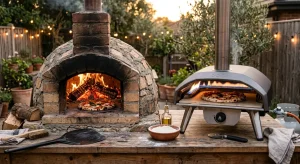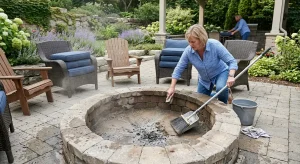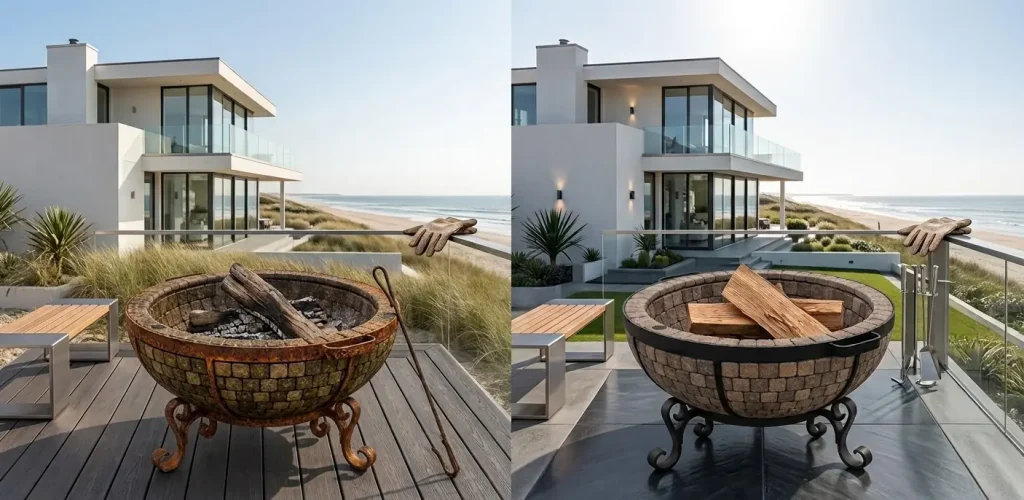
If you live near the coast, choosing the right boma fire pit for coastal environments requires more consideration than simply picking a design you like. Salt-laden air, humidity, moisture and sea spray can accelerate corrosion, particularly on untreated metal. The best fire pits for coastal environments are generally made from corrosion-resistant or non-metallic materials such as refractory clay, ceramic or suitable marine-grade stainless steel, although metal-frame fire pits can also be used successfully when properly treated and maintained.
Why Coastal Environments Are Hard on Fire Pits
Coastal environments can be particularly harsh on outdoor products because of the combination of salt, moisture and humidity. Salt particles carried through the air can settle on the surface of a fire pit, while rain and humidity provide the moisture needed for corrosion to develop.
This is particularly relevant for metal fire pits. Even if a fire pit looks durable when it is new, untreated or poorly protected steel can begin developing rust relatively quickly when exposed to coastal conditions.
The closer your property is to the ocean, the greater the potential exposure. A fire pit on a beachfront patio will generally experience more salt spray than one positioned several kilometres inland.
This does not mean that you cannot use metal fire pits near the coast. It simply means that the material, protective treatment and maintenance should be considered carefully before making a purchase.
What Makes a Fire Pit Suitable for Coastal Use?
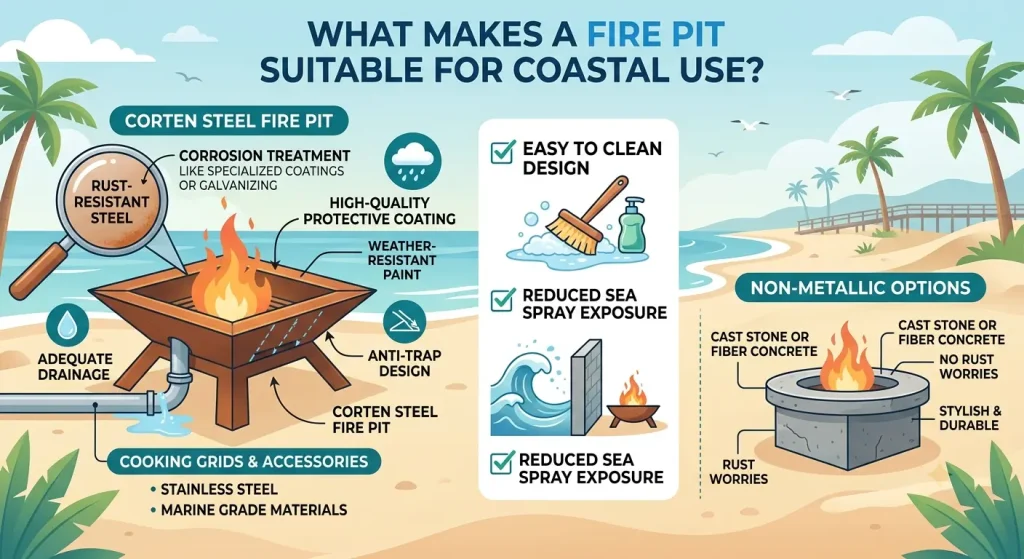
When choosing a coastal fire pit, look beyond its appearance and price. The construction materials and protective treatments are particularly important.
Consider:
- The material used to construct the fire pit
- Whether metal components have been treated against corrosion
- The quality of any protective coating
- Whether the fire pit has adequate drainage
- Whether water can become trapped inside the structure
- The materials used for cooking grids and accessories
- How easy the fire pit is to clean
- How exposed it will be to direct sea spray
A good coastal fire pit should be able to cope with outdoor exposure while still being practical to maintain.
For properties that are heavily exposed to the sea, non-metallic fire pits can be particularly attractive because they remove many of the corrosion concerns associated with conventional steel.
Refractory Clay Fire Pits
Refractory clay is one of the materials worth considering when choosing a fire pit for a coastal environment.
Refractory clay is specifically designed to withstand high temperatures, making it suitable for products that are repeatedly exposed to intense heat. It also provides a very different appearance from conventional steel fire pits.
Rather than looking like a piece of outdoor furniture, a clay fire pit can become a more permanent feature of a patio, garden or entertainment area.
Bluestone Fires, for example, manufactures handcrafted fire pits using specialist fire clay. Its products are individually moulded and kiln-fired, with options including Boma fire pits and fire slabs.
Clay fire pits can therefore be particularly appealing for coastal homeowners who want a durable outdoor fire feature without relying entirely on exposed metal.
Are Stainless Steel Fire Pits Good for Coastal Areas?
Stainless steel is another popular material for outdoor fire pits, but the particular grade of stainless steel is important.
Not all stainless steel provides the same level of corrosion resistance. For coastal environments, 316 stainless steel is generally considered a better option than 304 stainless steel because it has improved resistance to chloride exposure.
This is particularly relevant for homes that are close to the ocean or regularly exposed to sea spray.
However, even marine-grade stainless steel should not simply be installed and forgotten about. Salt deposits can accumulate on the surface and should be removed regularly.
A simple rinse with fresh water can help remove salt and other contaminants. Keeping the surface clean is particularly important for fire pits that are exposed to direct coastal conditions.
If you are considering a stainless steel fire pit for a coastal property, ask the supplier which grade of stainless steel is being used rather than relying solely on the term “stainless steel”.
Can Metal Fire Pits Be Used Near the Coast?
Yes. Metal-frame fire pits can be used in coastal environments when the metal has been correctly treated and is properly maintained.
This is worth highlighting because coastal conditions do not automatically rule out metal fire pits.
Mild steel, for example, can be protected using appropriate corrosion-resistant treatments and high-temperature coatings. The effectiveness of the protection depends on the preparation, treatment and quality of the coating.
Areas such as welds, joints, bolts, feet and the underside of the fire pit can be particularly vulnerable because moisture and salt can collect in these areas.
If you are considering a metal fire pit for a coastal home, look for one that has:
- Adequate metal thickness
- Proper corrosion protection
- A suitable high-temperature coating
- Good drainage
- Minimal areas where water can collect
- A finish that can be maintained or repaired
It is also important to remember that fire pits are exposed to considerably higher temperatures than ordinary outdoor furniture. Any protective coating therefore needs to be suitable for the temperatures the fire pit will experience.
What About Corten Steel Fire Pits?
Corten steel, sometimes called weathering steel, is popular for fire pits because of its distinctive rust-coloured appearance.
The material is designed to develop a protective patina over time, which helps slow further corrosion under suitable environmental conditions.
However, coastal environments can be more challenging for Corten steel.
Salt and chloride exposure can affect the normal weathering process, particularly when the fire pit is exposed to direct sea spray. This means Corten steel should not automatically be considered the best material for a beachfront fire pit.
Corten can still be suitable for some coastal properties, particularly where the fire pit is positioned in a sheltered area away from direct sea spray. However, it is worth discussing the specific environment with the manufacturer before purchasing.
There is also another consideration. As Corten steel develops its characteristic patina, rust-coloured runoff can occur. This may stain light-coloured paving or other surfaces underneath the fire pit.
Are Ceramic Fire Pits Suitable for Coastal Areas?
Ceramic and other heat-resistant non-metallic fire pits can also be worth considering for coastal properties.
One of the biggest advantages is that the main body of the fire pit does not rely on conventional steel, reducing concerns about the bowl itself developing rust.
However, the fact that a fire pit is ceramic or clay does not mean it is completely maintenance-free. Accessories such as cooking grids, brackets, handles and stands may still contain metal components.
The fire pit should also be specifically designed for outdoor use and capable of handling repeated heating and cooling.
Which Fire Pit Materials Should You Avoid Near the Ocean?
There is no single material that should always be avoided in coastal areas. Construction quality, treatment and positioning all make a difference.
However, inexpensive fire pits made from thin, untreated mild steel should be approached with caution.
Bare steel can develop surface rust relatively quickly when exposed to salt and moisture. Once corrosion starts, it can progressively weaken the metal and affect the appearance of the fire pit.
Poor-quality coatings can create similar problems. If the coating becomes chipped or scratched, moisture and salt can reach the underlying metal and corrosion can develop.
This does not mean that painted or powder-coated steel cannot be used near the coast. Properly treated metal can perform well. The important factor is the quality of the treatment and whether the fire pit is maintained correctly.
How to Protect a Coastal Fire Pit
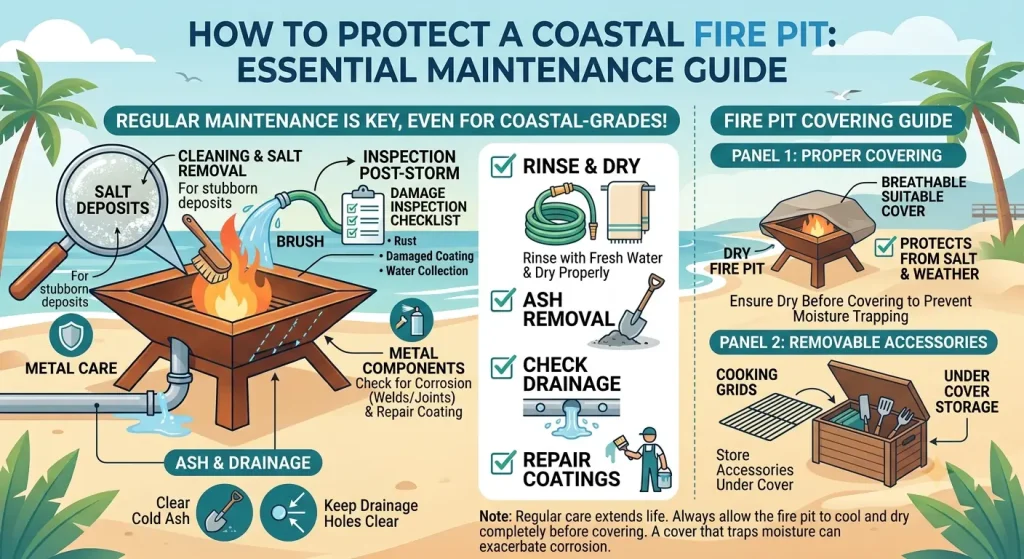
Even a fire pit specifically chosen for coastal use will benefit from regular maintenance.
One of the simplest things you can do is keep the fire pit clean. Salt should not be allowed to accumulate on exposed surfaces for long periods.
After particularly windy weather or storms, inspect the fire pit for salt deposits, rust, damaged coatings or areas where water may have collected.
Depending on the material, useful maintenance can include:
- Rinsing exposed surfaces with fresh water
- Removing salt deposits
- Allowing the fire pit to dry properly
- Clearing ash once the fire is completely cold
- Keeping drainage holes clear
- Checking metal components for early signs of corrosion
- Repairing damaged protective coatings
- Storing removable accessories under cover
- Using a suitable outdoor cover when the fire pit is not being used
A cover can provide additional protection, but the fire pit should be dry before it is covered. A cover that traps moisture against the surface can potentially make corrosion worse rather than better.
Where Should You Position a Coastal Fire Pit?
The location of your fire pit can have a significant effect on its lifespan.
A fire pit positioned directly on an exposed beachfront terrace will experience considerably more salt spray than one positioned in a sheltered garden.
Where possible, choose a location that is protected from prevailing winds and direct sea spray. This can reduce the amount of salt deposited on the fire pit.
You should also consider the surface underneath it. Some materials can be stained by rust runoff, ash or soot. This is particularly worth considering when installing a Corten steel fire pit.
Safety should also remain a priority. Maintain suitable clearance from buildings, trees, roofs, outdoor furniture and other combustible materials, and always follow the manufacturer’s installation instructions.
Choosing the Right Fire Pit for Your Coastal Home
The best coastal fire pit ultimately depends on how exposed your property is and what type of maintenance you are prepared to carry out.
For highly exposed beachfront properties, refractory clay and suitable marine-grade stainless steel can be strong choices. A properly treated metal-frame fire pit can also work well, particularly when positioned away from direct sea spray.
Corten steel may be suitable in some coastal locations, but it deserves more careful consideration where salt exposure is high.
The key is to match the material to the environment rather than choosing a fire pit based solely on appearance.
Where to Buy a Coastal Safe Fire Pit
When buying a fire pit for a coastal property, it is worth choosing a specialist supplier that can explain the construction, materials and maintenance requirements of its products.
Bluestone Fires is one South African supplier offering fire pits suitable for outdoor entertaining. The company specialises in handcrafted fire ware, including fire pits, fire slabs and pizza ovens, and manufactures its fire pits using specialist fire clay and kiln-firing.
Its range includes Boma fire pits in different sizes and finishes, providing options for different outdoor spaces.
For coastal homeowners, it is still advisable to discuss the intended location with the supplier before purchasing. A fire pit positioned directly beside the ocean may have different requirements from one installed in a sheltered coastal garden.
You can view the available options from Bluestone Fires and consider which design and material best suits your outdoor space.
Final Thoughts
Choosing a fire pit for a coastal environment is largely about choosing the right material and taking care of it properly. Refractory clay, ceramic and suitable marine-grade stainless steel can all be good choices, while a correctly treated metal-frame fire pit can also perform well.
The important thing is not to assume that every fire pit will withstand coastal conditions equally. Salt, moisture and sea spray can significantly accelerate corrosion, particularly on untreated metal.
Choose a fire pit that suits your level of exposure, position it where possible away from direct sea spray and give it regular maintenance. With the right combination of material, placement and care, you can enjoy a fire pit for years even when your home is close to the coast.